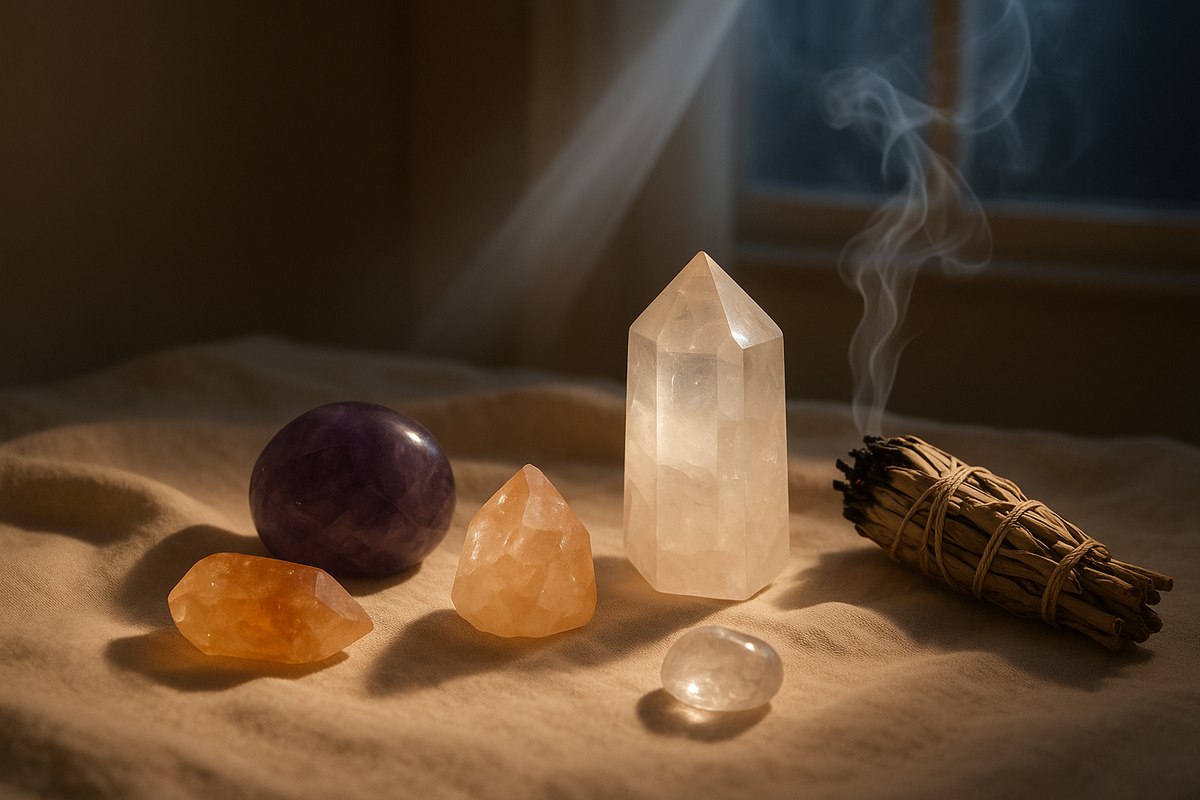
How to Cleanse Crystals: 5 Simple Methods
Crystals absorb energy; learn five safe, practical methods-smoke, moonlight, salt, sound, and selenite-to cleanse and recharge them.

How to Cleanse Crystals: 5 Simple Methods
Cleansing your crystals helps reset their energy, removing any negativity they’ve absorbed. Here are five effective methods to keep your crystals energized and ready to support you:
- Smoke Cleansing: Use materials like sage, palo santo, or incense to clear energy by passing your crystals through the smoke.
- Moonlight: Place your crystals under the moonlight, ideally during a full moon, for a gentle energy refresh.
- Salt: Use a dry salt bed or a saltwater bath (only for water-safe stones) to absorb unwanted energy.
- Sound: Vibrations from singing bowls, tuning forks, or bells can cleanse crystals without physical contact.
- Crystal Clusters or Selenite: Rest your crystals on selenite or quartz clusters to naturally recharge them.
Each method works differently depending on your crystals’ properties and your preferences. Handle delicate stones carefully, avoid water for porous or soft crystals, and always prioritize safe and ethical practices.
Why and When to Cleanse Crystals
Common Reasons for Cleansing
Crystals naturally soak up the energy around them - whether it's from daily stress, emotional experiences, or the surrounding environment ¹. Arun Yadav, CEO of Beads Of Cambay, explains it well:
"Crystals are like sponges that absorb energy from their surroundings, including both positive and negative energies. When we use them for healing, meditation, or other metaphysical purposes, they accumulate these energies. Over time, this accumulation can lead to a depletion of the crystal's natural energy and make it less effective" ³.
When you bring home a new crystal, it’s important to cleanse it right away to clear any lingering energies from its journey ⁴. Regular cleansing is also essential after using crystals for healing, meditation, or protection, as these activities can leave them saturated with intense energy ¹. If you're going through a tough time, your crystals might be absorbing more than usual and could benefit from more frequent cleansing ⁴. Pay attention to how your crystals feel - if they seem dull or less vibrant, it might be time to refresh their energy ¹.
The frequency of cleansing depends on how much energy your crystals are absorbing and how often they’re used.
How Often to Cleanse
For crystals that are used as decoration or only occasionally, a monthly cleanse is usually sufficient. However, if you use your crystals daily for healing or spiritual practices, a weekly cleanse is recommended ⁴, ⁵. Healing stones, in particular, should be cleansed both before and after each session to avoid transferring unwanted energy ¹.
Trust your intuition as you get to know your crystals. Many practitioners adjust their cleansing routines based on how their stones feel or how often they’re used ⁵.
Knowing how often to cleanse is key to picking the right method for your crystals.
Crystal Care Basics
Not all crystals are created equal when it comes to care. Water-sensitive stones like selenite, halite, and desert rose can deteriorate if exposed to moisture ⁷. Similarly, salt can harm softer stones, and direct sunlight may fade vibrant crystals like amethyst and rose quartz ⁷. Before choosing a cleansing method, it’s crucial to understand your crystal’s properties - things like hardness, porosity, metal content, and sensitivity to light - to avoid accidental damage and keep your crystals in their best condition ⁸.
HOW TO CLEANSE YOUR CRYSTALS | 7 WAYS TO CLEANSE YOUR CRYSTALS | AVOID THESE 3 THINGS |
1. Cleansing with Smoke
Smoke cleansing is a time-honored tradition found in many cultures, used to clear spaces, objects, and energy of negativity. The idea is that the smoke binds to unwanted energy and carries it away as it drifts upward, leaving your crystal refreshed and restored ¹⁴,²⁸. This technique is particularly suited to all types of crystals, including delicate or porous ones like selenite, celestite, and kyanite, which shouldn't be exposed to water ¹⁴,²⁶.
Common materials used for smoke cleansing include palo santo and white sage. Palo santo, meaning "Holy Wood", is harvested from a sacred tree native to South America and has been used in spiritual ceremonies for generations by indigenous communities ²⁹,³⁰,³². White sage, an aromatic herb, has long been part of Native American purification practices ²⁹,³¹. Incense options like sandalwood, frankincense, lavender, and cedar are also effective alternatives ¹⁴,²⁶,²⁸.
When choosing your materials, prioritize ethically sourced options. Sustainable harvesting is critical, as overharvesting can harm these natural resources. As All Crystal advises:
"Always ensure to purchase, and only use, Palo Santo that has been ethically and sustainably sourced, as the overharvesting of Palo Santo can lead to the species becoming endangered" ⁹.
Once you’ve gathered your responsibly sourced tools, you’re ready to begin.
Step-by-Step Guide to Smoke Cleansing
Start by opening a window or door to allow for proper airflow and to give negative energy an exit. Gather your materials: a smudge stick (such as sage or palo santo), incense, a lighter, and a fireproof container like an abalone shell, ceramic bowl, or metal dish to catch any ash.
Before lighting, take a moment to center yourself. Visualize the smoke sweeping away negativity and welcoming positive energy into your space. Hold the smudge stick at a 45-degree angle, light the tip for about 20-30 seconds (or up to a minute for palo santo), then gently blow out the flame to create a steady stream of smoke.
Take one crystal at a time and pass it through the smoke, ensuring all sides are exposed. Alternatively, you can wave the smoke over your crystals with your hand or a feather. Spend about 30-60 seconds on each crystal, or until you sense its energy feels lighter. Once done, press the smudge stick into the fireproof dish to extinguish it completely - avoid using water, as it can damage the material.
Safety and Eco-Friendly Tips
When working with fire, safety should always come first. Never leave burning sage, palo santo, or incense unattended, and keep them away from flammable materials. Ensure proper ventilation, as heavy smoke can set off alarms or become overwhelming in small spaces. Additionally, keep your crystals a safe distance from direct flames or hot ash to prevent burns or cracks. By taking these precautions, you can cleanse your crystals effectively and responsibly.
2. Cleansing with Moonlight
Cleansing your crystals with moonlight is one of the gentlest and safest ways to clear and recharge their energy. Unlike methods like smoke or salt cleansing, moonlight is soft enough not to damage even the most delicate stones. As moonlight is a faint reflection of sunlight - roughly 400,000 times dimmer - it is believed to both clear negative energy and restore the vitality of your crystals¹³.
The full moon is often considered the ideal time for this practice. Its peak energy, associated with completion and release, makes it perfect for removing stagnant energy and infusing your crystals with fresh energy. However, you don’t have to wait for the full moon - cleansing during any moon phase works just fine. Many practitioners prefer a three-day window around the full moon - the night before, the night of, and the night after - for the best results¹¹, ¹². Here’s how to harness moonlight for your crystal cleansing ritual.
Using Moonlight for Crystal Cleansing
Start by preparing your crystals. If they’re dusty, rinse them with cool water (if they’re safe for water) or use a smoke cleansing method. Once they’re clean, find a spot where they’ll be exposed to unobstructed moonlight. This could be outdoors on natural surfaces like soil or wood, or indoors on a windowsill or balcony. Natural surfaces are often preferred over materials like metal or concrete, which some believe might disrupt the energy flow.
Before placing your crystals under the moonlight, take a moment to set your intentions. Think about what you want to achieve with their energy. Arrange your crystals so they’re positioned to catch the moonlight. Don’t worry if the sky is cloudy - the moon’s energy can still reach your crystals. Leave them out from dusk until dawn to ensure they receive a full lunar recharge.
Care Notes for Moonlight Cleansing
It’s important to retrieve your crystals within an hour of sunrise to avoid prolonged exposure to direct sunlight. Some stones, such as amethyst, rose quartz, aquamarine, citrine, fluorite, and smokey quartz, can fade when exposed to too much sunlight. Clear quartz, on the other hand, can concentrate sunlight and potentially pose a fire risk¹⁰.
If you’re placing your crystals outdoors, take precautions to protect them from weather and wildlife. Water-sensitive stones like selenite, malachite, azurite, and celestite should stay indoors on a windowsill or be covered with a clear container that allows moonlight to pass through. Choose a safe, secure spot to protect your crystals from theft or damage. If rain is expected, quartz crystals may enjoy a natural rinse, but be cautious with stones you’re less familiar with.
3. Cleansing with Salt
Salt has been a trusted tool for absorbing and neutralizing negative energy for centuries. When it comes to cleansing, it offers a tactile and effective way to purify and refresh energy. There are two main methods: dry salt and saltwater. Each serves a specific purpose. Dry salt is excellent for absorbing negativity and purifying crystals, especially delicate ones that can’t handle moisture. Saltwater, on the other hand, not only cleanses but also recharges a crystal’s energy, though it’s more intense and can potentially damage certain stones¹⁴.
The choice between the two methods depends on the type of crystal and the level of cleansing required. Dry salt is gentler and safer for fragile stones, while saltwater provides a deeper cleanse but should be used cautiously.
Dry Salt Bed vs. Saltwater Bath
For a dry salt cleanse, you can place your crystals in a glass bowl filled with natural, unrefined salt, such as sea salt or Himalayan salt, for several hours or up to 24 hours¹⁴, ¹⁵. If your crystal is particularly sensitive, you can place it in a smaller bowl and then put that bowl inside the larger salt-filled container. This setup avoids direct contact with the salt while still drawing out unwanted energy¹⁴, ¹⁵.
Saltwater cleansing involves dissolving sea salt or rock salt in filtered water and submerging your crystals for a few hours or overnight. This method not only cleans but also revitalizes the crystal’s energy. However, it’s not suitable for all stones. Crystals like selenite, malachite, calcite, and pyrite can be damaged by water, while porous stones like lapis lazuli and opal, or those containing metal like hematite, should also avoid saltwater¹⁴, ¹⁵, ¹⁶. After cleansing, always rinse your crystals thoroughly with fresh water to remove any salt residue², ¹⁴, ¹⁵.
Safety Considerations for Salt Cleansing
Salt’s abrasive and corrosive nature can harm certain crystals, causing discoloration or even dissolving them¹⁷. Crystals generally safe for salt cleansing include varieties of quartz (like clear quartz, amethyst, and citrine), carnelian, black obsidian, black tourmaline, jasper, and labradorite¹⁴. However, even these can be affected if salt seeps into cracks or fissures, as it might recrystallize and cause damage once the water evaporates. Treated, coated, or dyed crystals should also avoid salt cleansing¹⁴, ¹⁸. If you’re uncertain, try the method on a less expensive crystal first to ensure it’s safe¹⁷.
Eco-Friendly Salt Disposal
Once the cleansing process is complete, the salt used has absorbed negative energy and should not be reused¹⁵. Dispose of it responsibly by flushing it down the drain with running water or discarding it in the trash¹⁴, ¹⁵. If flushing, only small amounts should go down household drains to avoid harming aquatic ecosystems. Avoid dumping large quantities into natural waterways to protect the environment.
4. Cleansing with Sound
Sound cleansing offers a gentle, contact-free way to refresh your crystals. By using vibrations, this method interacts with a crystal's energy field, helping to clear away negative energy and restore its natural balance ²⁰, ²², ²³.
One of the biggest advantages of sound cleansing is its versatility. Unlike water or salt-based methods, which can sometimes harm delicate stones, sound cleansing is safe for all types of crystals. It's also a great option for small spaces or when dealing with a large collection, as it doesn’t require moving your crystals outdoors for methods like moonlight cleansing ²⁰, ²³.
Using Sound Tools
A variety of sound tools can be used for cleansing. Singing bowls, especially Tibetan bowls, produce soothing tones when struck or rubbed with a mallet. To avoid damaging your crystals, place them near the bowl rather than inside it ¹⁹, ²⁰, ²². Tuning forks are another option - they produce precise frequencies when struck against a surface. Simply hold one close to your crystals, allowing the vibrations to resonate ²⁰, ²². Bells, chimes, and even drums can also create clear, cleansing sounds to dispel unwanted energy.
Crystal expert Hibiscus Moon explains, "Because any sound is sound acoustic energy as long as its high amplitude… doesn't matter what note or frequency it's in. You just want it to be high energy; i.e. LOUD, where you can feel it reverberating." ²³ These tools not only clear energy effectively but are also convenient for quick, on-the-go cleansing.
Benefits of Sound Cleansing
Sound cleansing is incredibly convenient and requires little preparation - just a quiet space and your chosen sound tool. Unlike other methods, there’s no risk of water damage, salt corrosion, or fading ²⁰, ²³. The process is simple: set your intention, create the sound, and let the vibrations do their work. Whether you spend a minute or several, the duration is entirely up to you ¹⁹, ²³.
janTheGreenWitch from Higher Love shares:
"I believe that the duller the noise, the denser and more clogged up that area is. You may need to make the sound several times before you notice the tone becoming higher, clearer, and cleaner." ²¹
This insight highlights how sound cleansing not only clears energy but also strengthens your connection with your crystals, making the practice both effective and rewarding.
5. Cleansing with Crystal Clusters or Selenite
If you're looking for a low-effort way to cleanse your crystals, using crystal clusters or selenite plates is a fantastic option. These "master crystals" naturally emit high-energy vibrations that help purify and recharge smaller stones placed on or near them. Plus, clusters and geodes have a larger surface area, allowing you to cleanse several crystals at once - perfect for streamlining your crystal care routine.
Using Clusters and Selenite
The process couldn't be easier. Simply place your crystals on a selenite charging plate, a clear quartz cluster, or an amethyst geode. Direct contact maximizes the cleansing effect. If you're using a selenite slab, it's especially handy for crystals with flat surfaces that can rest securely on it. For smaller stones, you can also use a bowl filled with small clear quartz pieces as an alternative.
Leave your crystals on the cleansing surface for anywhere from 6 to 48 hours, depending on how much energy clearing they need. Overnight works well for most situations. Some practitioners suggest keeping your charging clusters in a sacred or high-energy space to further enhance their power.
Care and Maintenance of Selenite
Taking good care of your selenite ensures it remains effective and gentle for cleansing. While selenite and clear quartz are self-cleansing and don't require frequent attention, selenite may benefit from occasional refreshing. This is especially true if it has absorbed a lot of negative energy or if it's a new addition to your collection. To refresh selenite, leave it under moonlight overnight or expose it to sunlight for 30 to 60 minutes. Avoid leaving it in direct sunlight for more than 4 hours, as this can cause damage.
Selenite is delicate, so handle it carefully to prevent scratches. Never expose it to water, as it can dissolve or become damaged when wet. A soft, dry cloth is all you need to keep it clean and ready for its next use.
Quick Reference: Comparing Cleansing Methods
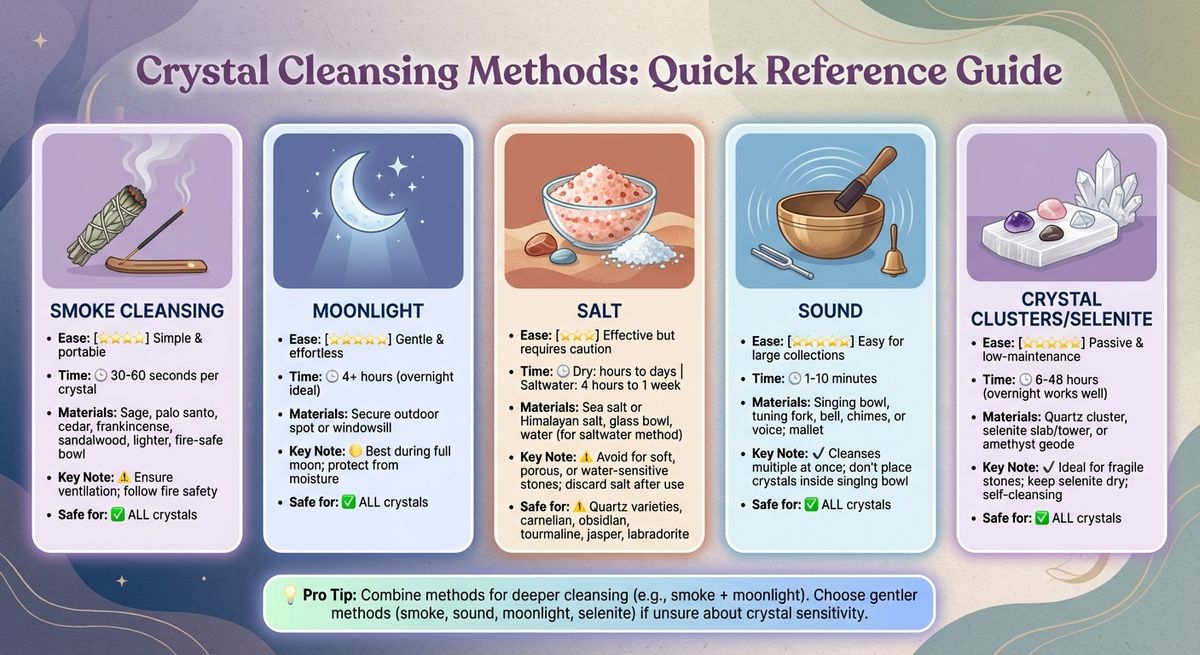
Here's a handy comparison of five popular crystal cleansing methods, designed to help you choose the best approach based on your needs. Whether you're dealing with fragile stones, need a travel-friendly option, or want something quick and simple, this guide has you covered.
Comparison Table
Each method comes with its own benefits, making it easier to tailor your choice to your situation. The table below highlights essential details like ease of use, time commitment, materials required, and safety tips to ensure your crystals are cleansed effectively and safely.
Method / Ease of Use / Time Required / Materials Needed / Key Considerations
- Method: Smoke; Ease of Use: Simple and portable; works for all crystals; Time Required: 30-60 seconds per crystal; Materials Needed: Sage, palo santo, cedar, frankincense, or sandalwood; lighter; fire-safe bowl; Key Considerations: Ensure proper ventilation by opening windows, and follow fire safety guidelines
- Method: Moonlight; Ease of Use: Gentle and effortless; safe for all crystals; Time Required: At least 4 hours (overnight is ideal) or a full lunar cycle for deeper cleansing; Materials Needed: A secure outdoor spot or a windowsill; Key Considerations: Keep crystals protected from moisture like rain or dew; works best during a full moon
- Method: Salt; Ease of Use: Dry salt is safe and effective; saltwater is stronger but riskier; Time Required: Dry salt: several hours to days. Saltwater: 4 hours to 1 week; Materials Needed: Sea salt or Himalayan salt; glass bowl (avoid metal); water (for saltwater); Key Considerations: Avoid for soft, porous, or water-sensitive stones; discard used salt after cleansing
- Method: Sound; Ease of Use: Easy and perfect for large collections; Time Required: 1-10 minutes; Materials Needed: Singing bowl, tuning fork, bell, chimes, or your voice; mallet for a singing bowl; Key Considerations: Cleanses multiple crystals at once; avoid placing crystals inside a singing bowl to prevent damage from vibrations
- Method: Crystal Clusters/Selenite; Ease of Use: Passive and low-maintenance; Time Required: 6-48 hours (overnight works well); Materials Needed: Quartz cluster, selenite slab or tower, or amethyst geode; Key Considerations: Ideal for fragile stones; keep selenite dry to maintain its integrity; requires minimal upkeep as selenite is self-cleansing
If you're unsure about your crystal's sensitivity to water or light, opt for gentler methods like smoke, sound, moonlight, or selenite clusters. You can also combine techniques, such as smoke cleansing followed by moonlight exposure, for a more thorough recharge.
Conclusion: Choosing the Right Method for You
When it comes to cleansing your crystals, the best method depends on both the unique properties of your stones and your personal preferences. Some crystals are sensitive to water, salt, or extended sunlight exposure, so it’s essential to know your stone’s characteristics before deciding. For example, if your crystal has a Mohs hardness below 6, it’s best to steer clear of water-based methods ⁶.
Trust your instincts when selecting a cleansing method that fits seamlessly into your daily life. You might find that moonlight works beautifully for stones used in emotional healing, while grounding crystals thrive with earth-based practices. Feel free to mix techniques for a more thorough cleanse - like pairing smoke cleansing with a moonlight recharge during a full moon.
The comparison table above can help you decide which method suits your needs, whether you’re looking for something quick, portable, or ideal for managing a larger collection. Begin with a single technique that feels right for you and expand your practice over time. Regular, intentional cleansing not only keeps your crystals energetically refreshed but also strengthens your bond with their energy, ensuring they’re ready to support you in your journey.
FAQs
How can I choose the best way to cleanse my crystals?
The right way to cleanse your crystals depends on their specific characteristics and what feels right to you. For example, water-safe crystals like quartz or amethyst can be gently rinsed under running water. However, fragile or porous stones like selenite should steer clear of water and are better cleansed using methods like smoke, moonlight, or sound.
If you're unsure about your crystal's needs, consider smudging with sage or palo santo, placing them under the light of the moon, or using tools like a tuning fork or singing bowl to cleanse them with sound vibrations. Feel free to try out different techniques to discover what resonates best with your crystals and your personal intentions.
Can I use multiple methods to cleanse my crystals at once?
Yes, you can mix techniques like smudging, moonlight, and water cleansing** to give your crystals a more complete cleanse. Just be cautious - some crystals, such as selenite or malachite, are sensitive to water and can get damaged. Combining methods can enhance the cleansing process, keeping your crystals energetically refreshed while protecting their physical condition.
How do I know when my crystals need to be cleansed?
Crystals often signal the need for cleansing when they feel unusually heavy, seem dull compared to their usual sparkle, or don’t work as effectively as before. This can occur after they’ve been used frequently for healing, meditation, or when exposed to strong energy. Pay attention to your instincts - if your crystals feel energetically off, it’s probably time to give them a reset.